All four of our businesses live on being found, and none of them has the hours to keep writing. And this is a common problem! Everyone is looking to be found, discovered by their clients or customers.
As we've been setting up our agent tech to run our businesses (a safari lodge, hotel software, a Kenya trips company and a software studio), each business needs its own marketing and its own full loop of content and blog posts and all of that. So with SlopIt we're handling one big part of that, so that you can focus on the rest of your business, whatever your specialty is.
What happened on our own lodge's blog
We ran this on Mara Hilltop first. Posts start from real guest questions and my voice notes about the place, then research, writing, fact-checking and a read before anything goes live.
Here's what Google Search Console shows.
- Google clicks to the blog went from 86 in a month in June to 273 in the 28 days to 20 November. November is the low season at the lodge.
- The blog's pages showed up 15,900 times in Google's AI answers (Search Console's Generative AI features report, May to November 2026). One post alone showed up 4,428 times.
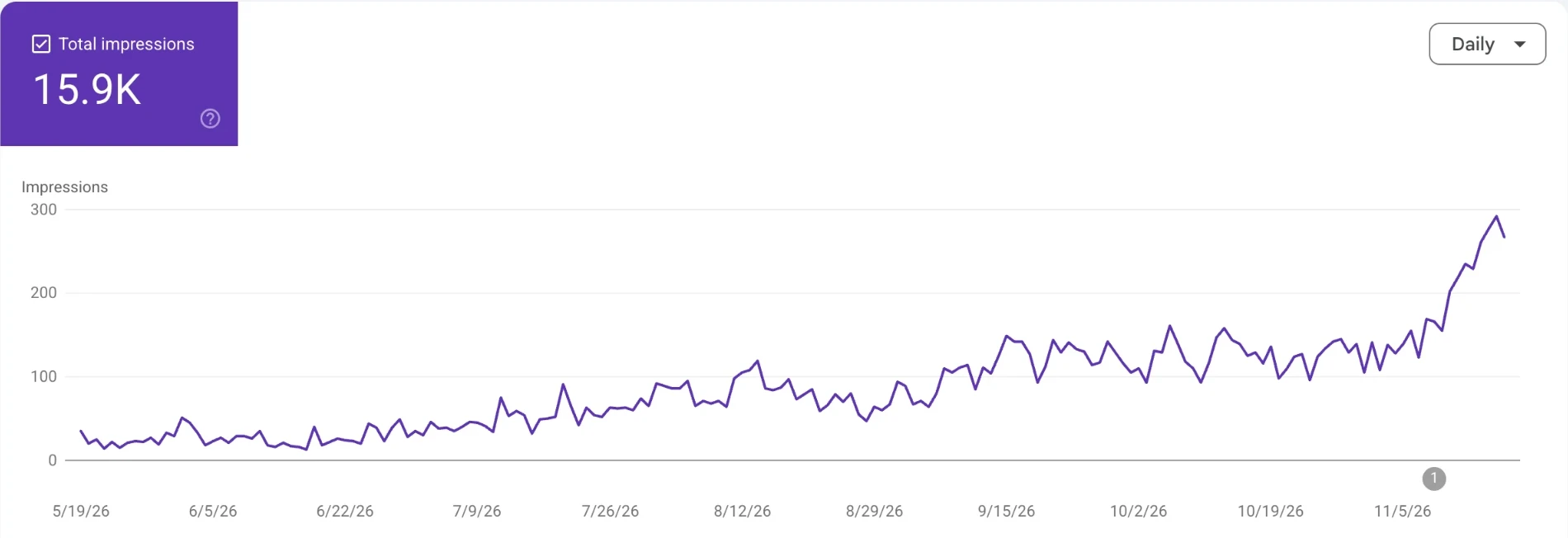
Search Console's Generative AI features report for the lodge's site, May to November 2026.
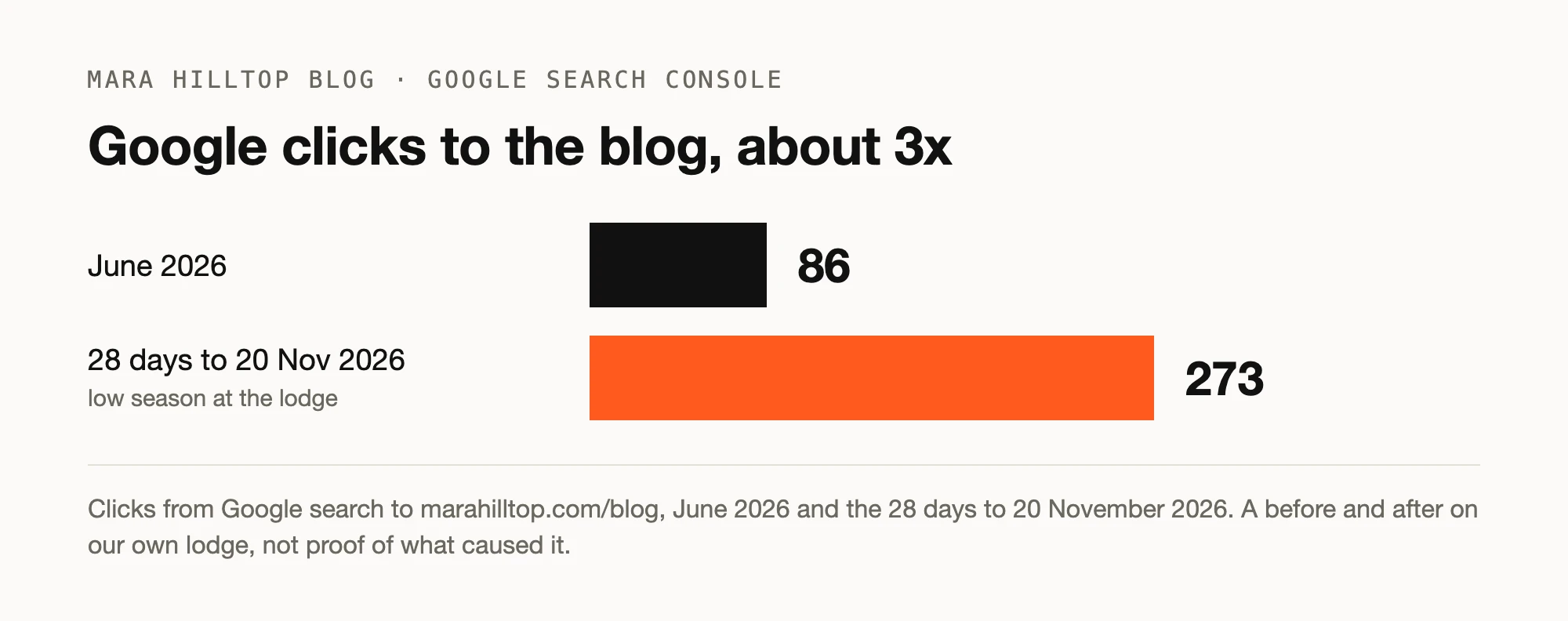
That's visibility. We're not claiming bookings from it.
You can read the blog yourself: the DIY Kenya safari post and Maa Cultural Week, as it happened are two of them.

One of the posts, live on marahilltop.com.
What gets you found now
AI loves to gobble up words, especially useful, helpful words that explain things. That helps a lot with Google and ChatGPT search. When someone asks ChatGPT, Gemini or Claude a question, or gets one of Google's AI answers at the top of the results, those answers are built from pages that actually answer the question.
The opposite is also true. Slop for the sake of slop is getting punished. Google's November core update finished rolling out this week (status page), and Google's spam rules already count pages mass-produced to game rankings as spam, whether AI or a person wrote them (spam policies, AI content guidance). So we need to make sure the quality is high and it's not spitting out slop.
Write what your customers ask
This is not just slop. We want businesses to write content that's helpful to their target audience, their customers and people in general.
If you're selling room nights like Mara Hilltop, it's helpful to talk about how far the Mara is from Nairobi, or how to get from Nairobi to the Masai Mara, and stuff like that. That's helpful content that someone sitting in Europe or the US will search for on ChatGPT. Similarly, if you're running an AC repair shop in a city, it's helpful to put out content about when to do maintenance and how to take care of your ACs, and everything else like that.
A few more examples, with the question a customer actually types and the post that answers it.
| Business | What the customer asks | The post |
|---|---|---|
| Dental clinic in Austin | how much does a teeth cleaning cost without insurance in austin | What a dental cleaning costs without insurance in Austin |
| Inventory software startup | how do i set reorder points for a small warehouse with seasonal demand | How to set reorder points when demand is seasonal |
| Bakery in Chicago | what size cake feeds 40 people and how do i carry it in a car | Cake sizes for 40 guests, and how to move one by car |
| Accountant in Toronto | what documents do i need for my first corporate tax return | What to gather before your first Canadian corporate tax filing |
| Wedding photographer in Tuscany | what time has the best light for outdoor wedding photos in july | When to schedule outdoor wedding photos in July in Tuscany |
| Online boot shop | how tight should new leather boots feel before they break in | How new leather boots should fit on day one |
| Strength gym | how do i start lifting weights at 40 if i have never used a barbell | How to start barbell training in your 40s |
How we keep it from being slop
We've spent a lot of months and effort and tokens to get the quality up. There's a lot of skills and human judgment and taste involved in how we've gotten our workflow and processes to a point where it creates good content. We will admit it'll probably not be the greatest piece written online, but the level we're going for is pretty good and indistinguishable from a human writer.
Slop, to me at least, is content that's wrong, padded, or generic. So every post goes through these steps.
- a fact sheet built from your site and your notes, so it doesn't make things up about your business
- research on what your buyers are actually searching for
- a fact-check
- two independent reviewers that look for AI-sounding writing, and right now a person on our team reads every post too
- your approval by email before anything goes live, on your own domain
What SlopIt does
You send your site and a few notes, typed or as a voice note, and we don't need a call. We research and write the posts, put them on your blog on your own domain, and email you each one to approve first. There's also a results page with your clicks, impressions and AI-assistant reads.
- Growth: 8 finished posts a month, $99/mo
- Studio: 12 posts a month, including founder-voice posts, translations and a newsletter, $299/mo
Those are holiday launch prices until 31 January 2027 (then $149 and $349), and you keep the launch price while you're subscribed. If you don't love your first post, you get a full refund.
And yes, we named it SlopIt. The name is the only sloppy thing we'll ever send you.
— NJ
I started and run Mara Hilltop, the lodge in this post, and SimbaStack, where we build AI agents and the systems they work in: KaribuKit (hotel software), RafikiGo (Kenya trips) and SlopIt. Want us to run your blog? Write to hello@slopit.io.