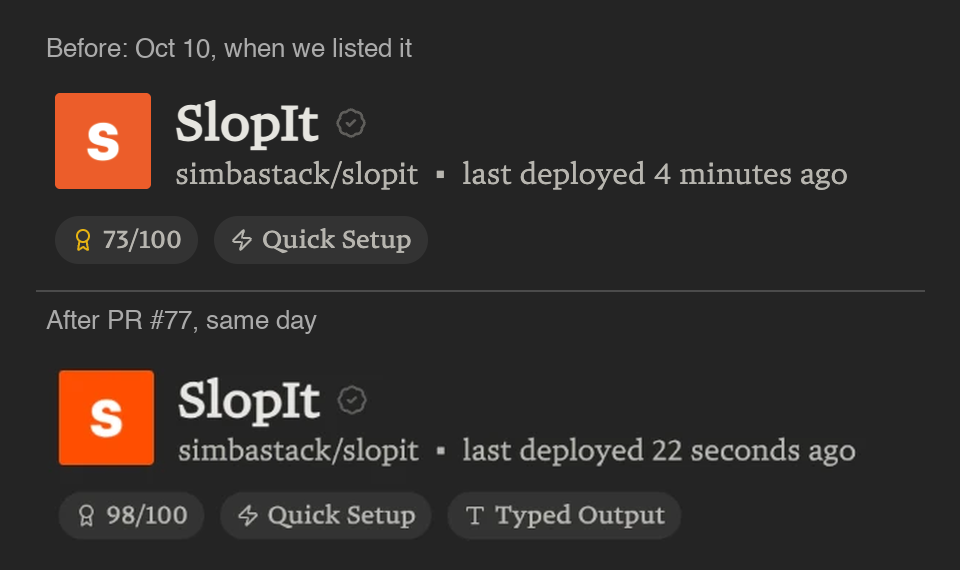
On October 10 we listed SlopIt's MCP server on Smithery, the official MCP Registry (as io.slopit/slopit) and Glama. Smithery gave it 73/100. One PR and a deploy later it was at 98, with a "Typed Output" badge. Most of the fix was metadata. The useful bit for anyone running an MCP server is a trap in outputSchema. The v1.x TypeScript client validates structuredContent against your output schema even when the tool call failed, so if your errors carry structuredContent and the schema is strict, every business error (POST_NOT_FOUND, UNAUTHORIZED) reaches the agent as a generic schema mismatch. It's a known SDK issue, typescript-sdk#2748.
SlopIt is a blog platform where the user is the AI agent. It signs up with one API call, sends markdown and gets a live URL back, so the MCP tools are things like signup, create_post and update_post.
Claude Code agents did the research and wrote the code, and my part was small. The 73 badge only has a tooltip ("Quality score based on MCP best practices and reliability"), so I typed "Maybe we should do some research and see how we can improve this?" and went off to claim our Glama listing. When the PR was ready I told Claude to merge it and deploy without asking me. About half an hour after I asked, Smithery showed 98.
What was missing
The hosted server is at https://slopit.io/mcp and has 12 tools. Every tool had a description and that was about it:
- 0 of 44 top-level parameters had a description
- no
outputSchemaon any tool - no
titleand no annotations - no server
instructions
Smithery doesn't publish how the score works. One server author's teardown says it's server metadata (35 points), configuration UX (25) and capability quality (40), and capability is checked per tool, for parameter descriptions, outputSchema, annotations and naming. It's unofficial, but it matched what we were missing.
What the PR changed
PR #77 went live the same day:
- a description on every parameter, including the nested
patchfields - a
titleand all four hints on every tool. Reads arereadOnlyHint, onlydelete_postanddelete_mediaaredestructiveHint, andopenWorldHintis false on all of them (more on that at the end) - an
outputSchemaon all 12 tools - server
instructionson initialize that walk the agent from signup to its first post
Claude's Connectors Directory asks for a title plus readOnlyHint or destructiveHint on every tool, so that part counts there too.
One idea came from a competitor, YeetIt. Their publish_website description tells the agent when to use it, "when a user asks you to build, create, or deploy a website", and what to tell the user afterwards, which is to share the live URL. Ours only said what each tool does. So now signup, create_post and update_post say when to use them and what to tell the human, like giving them the post_url.
Here's get_post before and after:
// before
server.registerTool('get_post', {
  description: 'Get a single post by its slug.',
  inputSchema: z.object({ blog_id: z.string(), slug: z.string() }).strict(),
}, handler)

// after
server.registerTool('get_post', {
  // title + readOnly, idempotent, openWorld: false
  ...meta('Get post', READ),
  description: 'Get a single post by its slug.',
  // BlogId and PostSlug carry .describe() text
  inputSchema: z.object({ blog_id: BlogId, slug: PostSlug }).strict(),
  outputSchema: PostOutput,
}, handler)
Your errors get validated too
When a SlopIt tool fails it returns isError: true, the error message as text, and the same error in structuredContent:
{ "error": { "code": "POST_NOT_FOUND", "message": "...", "details": {} } }
The server SDK skips output validation when isError is set, but the client in @modelcontextprotocol/sdk v1.x doesn't. Client.callTool checks structuredContent against the tool's outputSchema whenever it's there, error or not. (The comment right above that line says "not when there's an error", and then the code under it never looks at isError.) So the obvious schema, { post: Post } with post required, turns every POST_NOT_FOUND into this error.
MCP error -32602: Structured content does not match the tool's output schema
callTool throws that, so the agent never sees POST_NOT_FOUND, or the message telling it to find the right slug with list_posts (errors that say what to do next are on our agent-readable checklist).
#2748 has the details. The v2 client (@modelcontextprotocol/client) skips the check on errors, but v1.x still does it, and 1.32.1 is still the latest tag of @modelcontextprotocol/sdk on npm. It also only kicks in after the client has called tools/list, because that's when it caches the validators, so it can look random.
To be fair to the v1 maintainers, you can read this as our bug. The spec says servers MUST return structured results that conform to the output schema, and when a v1 PR tried to skip the check on errors, a maintainer asked why a server would put structuredContent on an error at all. The simplest fix is to not do that. We kept it because our SKILL.md and platform tests already rely on the error envelope being there, so instead:
- every success field is optional
- every schema also declares the
errorenvelope - objects are open at every depth (
z.looseObject), because in output mode Zod 4 putsadditionalProperties: falseon a plainz.object()and the next field you add would fail validation - no
formatchecks or regexes on outputs, because the client checks formats too and older rows don't always pass today's input rules
const toolOutput = (shape) =>
  z.looseObject({ ...shape, error: ErrorShape.optional() })
export const PostOutput = toolOutput({ post: PostShape.optional() })
The schema rejects a lot less now, but it still lists every field that comes back, with descriptions on the ones an agent has to act on (the API key's says "Shown once; save it."). Of the 20 tests the PR added, one calls every tool through the real Client.callTool after listTools(), with a success case and an error case. Make post required and the get_post error case fails with exactly that -32602. The write-up is in docs/solutions/mcp-output-schemas.md in our open-source core.
Two calls we're not sure about
update_post isn't marked destructive, even though it overwrites the post and can take a live post offline. We didn't want clients that respect destructiveHint asking for confirmation on every edit. OpenAI's plugin guidelines say the opposite, they list overwriting as destructive. openWorldHint is false everywhere because each tool only touches the caller's own blog, which those guidelines allow for a bounded account, but create_post does put things on the public web. We haven't settled either one.
To try SlopIt, paste this into Claude Code, Codex, Cursor or OpenClaw.
Start a SlopIt blog for me and publish a post about [your project]. Instructions: https://slopit.io/slopit.SKILL.md
— NJ